Welcome Message

Click the IBS-VdWQS logo above to visit the site.
.jpg)
PRINCIPAL
INVESTIGATOR
INVESTIGATOR
PRINCIPAL INVESTIGATOR JONG-HOON KANG
- Position
- Professor
- Tel
- +82-054-260-9202
- Location
- IBS POSTECH Campus #349
- jkang@postech.ac.kr
JONG-HOON KANG jkang@postech.ac.kr
-
• Senior Research Rellow, Center for van der Waals quantum solids, IBS
-
• Assistant Professor, Pohang University of Science and Technology (POSTECH)
-
• Il-Beom Endowed Chair Professor, POSTECH (일범 석좌교수)
-
• Science Fellow, POSCO TJ Park Foundation (청암 사이언스 펠로우)
HONORS & AWARDS
|
Outstanding Teaching Award, POSTECH, MSE |
3/16/2026 |
|
Teaching Excellence Award, POSTECH |
1/23/2026 |
|
Best Lecture Award, POSTECH |
2/16/2023 |
PROFESSIONAL ACTIVITIES
|
Finance Chair, Organizing Comittee, ENGE 2026
|
2025 – 2026 |
|
Committee Member, International Program Comittee, ICMOVPE XXII
|
2025 – Present |
|
General Chair, Tohoku-NTHU Exchange Program, MSE, POSTECH
|
2024 – 2025 |
|
Committee Member, 2D Materials Symposium, GCIM 2024
|
2023 – 2024 |
SHORT BIOGRAPHY
|
Jong-Hoon Kang, a materials scientist, is a Senior Research Fellow at the Center for van der Waals Quantum Solids (vdWQS), Institute for Basic Science (IBS), and an Assistant Professor at Pohang University of Science and Technology (POSTECH). Kang’s research covers thin film epitaxy and the precise synthesis of atomic-scale semiconductors and diverse quantum materials, such as low-dimensional materials, superconductors, semimetals, topological Weyl semimetals, and high-k dielectrics. His recent research interests include artificially designed van der Waals heterostructures tailored for next-generation electronics and quantum devices. Jong-Hoon Kang received his B.S. and M.S. degrees from Seoul National University before earning Ph.D. in Materials Science and Engineering from the University of Wisconsin-Madison in 2018, with a dissertation on atomic structure design in iron-based superconductors. He joined the faculty of the Department of Materials Science and Engineering at POSTECH in 2022, following a postdoctoral fellowship at the University of Chicago, where he investigated the synthesis of transition metal dichalcogenide (TMD) monolayer films and the creation of 3D nano-structured films for optical metamaterials. Earlier in his career, he worked as a research scientist at Samsung Electronics and LG Chem, developing advanced semiconductor processes for memory, logic, and optoelectronic devices. More recently, he has been exploring the atomic-scale epitaxy of novel quantum materials and the engineering of precise van der Waals heteroepitaxy. In 2022, he established the Atomic-scale Epitaxy and Quantum Materials Laboratory (EQML) at POSTECH. |
WELCOME TO EQML!

|
Our laboratory is dedicated to the interdisciplinary research of low-dimensional epitaxial thin films, nano-interface science, and the analysis of quantum phenomena to bridge fundamental materials physics with applied engineering. We strive to realize 'materials, properties, and functionalities on demand' by synthesizing atomic-scale heterostructures and hybrid quantum condensed matter. Beyond traditional semiconductors, our scope extends to topological materials and multi-dimensional van der Waals systems, enabling the precise control of crystal structures and defects at the atomic level. By integrating advanced growth techniques with nanoscale geometric designs, we explore unprecedented physical properties through atomic-resolution imaging and transport measurements. Ultimately, our goal is to develop next-generation platforms for information electronics, energy, and quantum science, including ultra-sensitive sensors and low-power quantum devices. Our laboratory is a member of IBS Center for Van der Waals Quantum Solids and focuses on research into two-dimensional van der Waals material devices with chemical vapor deposition method, leading to the discovery of new materials and their properties into future information technology. For more details, including our research, people, publications, facilities, and news, please visit the IBS vdwqs homepage.
We are actively seeking passionate individuals interested in epitaxial growth of two-dimensional materials via chemical vapor deposition. If you're interested in joining our team, please email professor Jong-Hoon Kang at jkang@postech.ac.kr. Please kindly attach your CV and include a summary of your research interests. We look forward to potentially collaborating with you on exciting scientific endeavors! |
RESEARCH INTERESTS
|
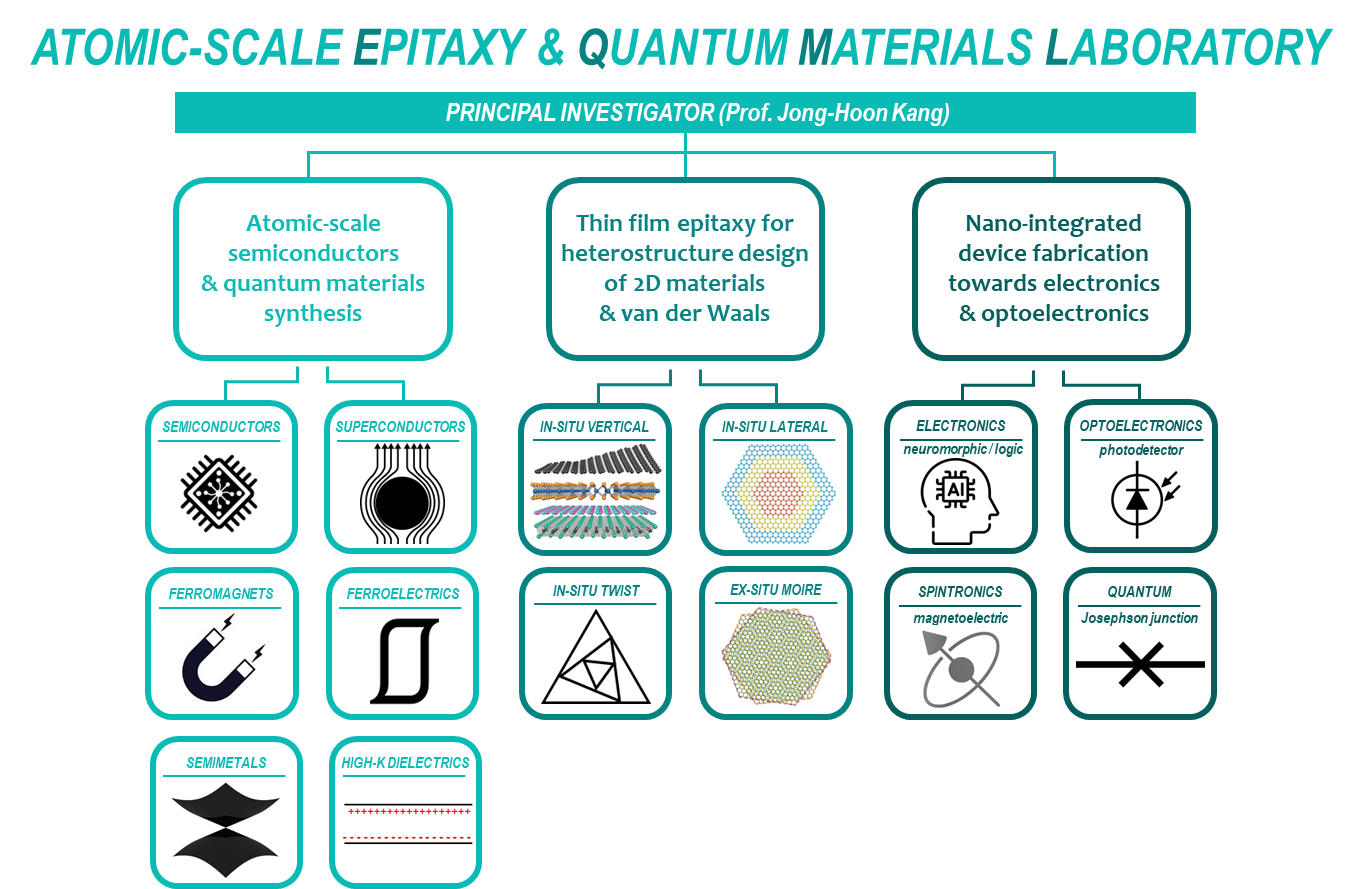
Atomic-scale Semiconductors & Quantum Materials Synthesis (materials on demand) Our research foundation lies in the precision synthesis of atomic-scale semiconductors and quantum materials. We explore a vast landscape of material systems, ranging from fundamental semiconductors and superconductors to complex ferromagnets, ferroelectrics, and semimetals. By utilizing advanced growth techniques, we aim to achieve high-quality crystalline structures and integrate them with high-k dielectrics. This broad material platform allows us to investigate intrinsic quantum properties and provides the essential building blocks for developing next-generation technologies. Thin Film Epitaxy for Heterostructure Design of 2D van der Waals Materials (properties on demand) We utilize advanced thin film epitaxy to engineer van der Waals heterostructures that go beyond naturally occurring materials. Our approach emphasizes in-situ engineering, employing both vertical stacking and lateral growth techniques to create pristine, contamination-free interfaces. Furthermore, we actively explore the field of "twistronics" by controlling the twist angle between layers to form in-situ twist structures and ex-situ moiré superlattices. This precise manipulation of lattice interactions enables us to engineer electronic band structures and uncover novel correlated physical phenomena. Nano-integrated Device Fabrication towards Electronics & Optoelectronics (functionalities on demand) The ultimate goal of our laboratory is to translate quantum material breakthroughs into tangible nano-integrated devices. We fabricate and characterize a wide array of functional devices, including neuromorphic and logic architectures for future electronics, as well as high-performance photodetectors for optoelectronics. Our research also extends to spintronics, exploiting magnetoelectric effects for low-power data processing, and quantum devices such as Josephson junctions, contributing to the advancement of quantum computing and information technologies.
|